UCL-Shanghai Jiaotong University Joint Funding Application
Joint funding application with Shanghai Jiaotong University for solar-thermal PEM electrolysis research.

Overview
Project Title
Thermally-Enhanced Electrochemical Hydrogen Production: UCL–SJTU Joint Platform Integrating Solar Thermal and PEM Electrolysis
Lead Applicants
UCL: Tianyi Ma, University College London
Specialisation: Electrochemical system modelling and experimental validationSJTU: Prof. Yanjun Dai
Head, Department of Power and Energy Engineering
Specialisation: Solar thermal systems, thermodynamic cycles, heat pumps
Project Rationale
Hydrogen is a critical vector for decarbonising hard-to-abate sectors. Despite advances in electrochemical hydrogen production, integration with solar thermal inputs remains underexplored, particularly in thermally-integrated PEM electrolysis systems.
This UCL–SJTU collaboration combines:
- UCL: Development of electrochemical testbeds for PEM electrolyser operation, catalyst-coated membrane fabrication, and dynamic characterisation under thermal-electrical coupling scenarios.
- SJTU: System-level design and simulation of photovoltaic-thermal (PVT) integrated PEM electrolysis platforms with heat pump coupling to enhance thermal utilisation and overall system efficiency.
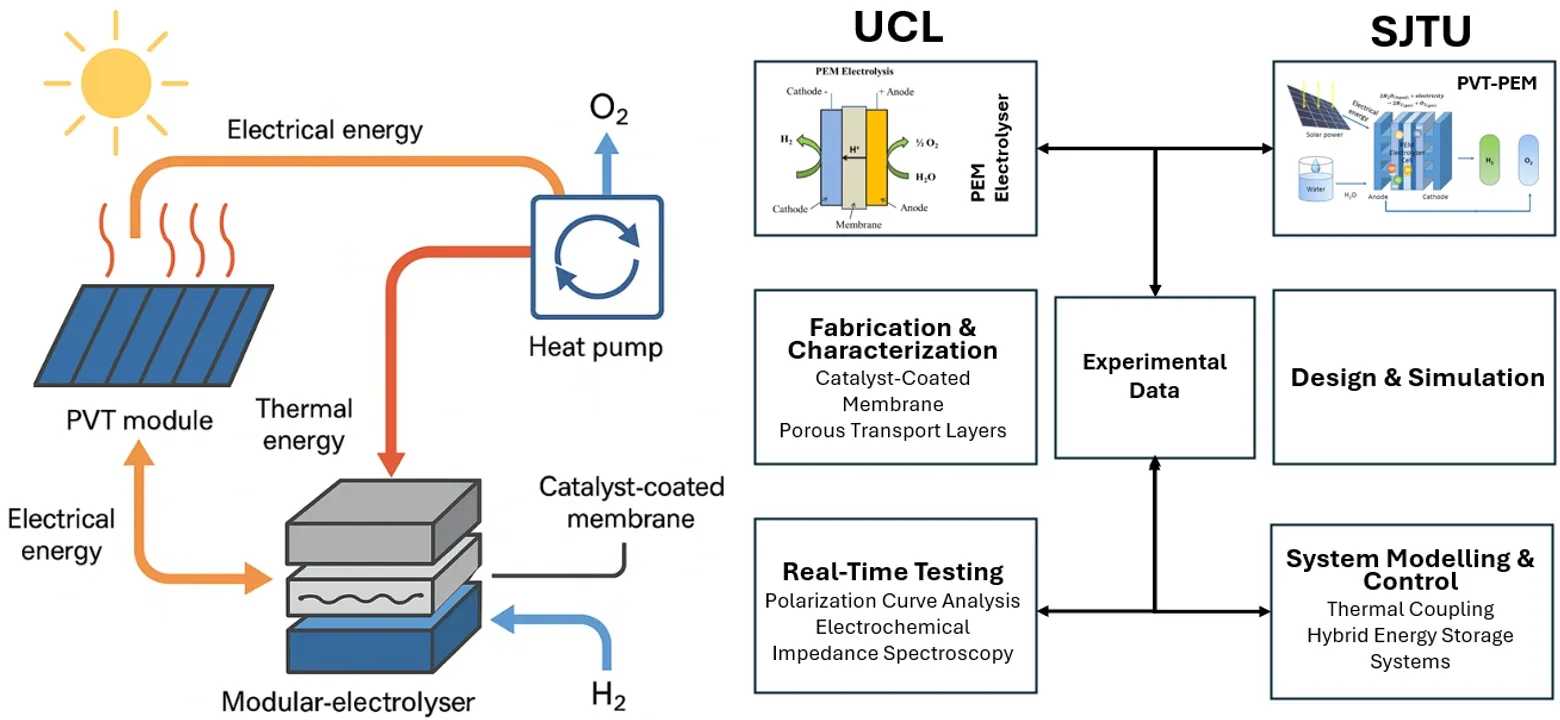 Methodology applied for this funding application.
The collaboration aims to:
- Increase thermal-electrochemical conversion efficiency under variable solar conditions
- Demonstrate replicable frameworks for electrochemical system integration research
- Support the UK Hydrogen Strategy and China’s clean energy transition objectives
Technical Highlights
UCL Work Packages
- Development of modular PEM electrolyser test platforms with integrated thermal control
- Dynamic performance evaluation under simulated solar-thermal input profiles
- Experimental characterisation of catalyst-coated membranes and porous transport layers under thermal gradients
SJTU Work Packages
- System-level modelling and optimisation of PVT-integrated PEM electrolysis systems
- Heat pump integration strategies for waste heat recovery and system efficiency enhancement
- Control strategy development for dynamic matching of thermal and electrical subsystems
Collaborative Workflow
- Empirical Data Generation (UCL): Electrochemical performance datasets under varying thermal conditions
- System Simulation Calibration (SJTU): Using experimental inputs to refine thermal-electrochemical models
- Feedback Loop: Iterative integration of materials-level characterisation with system-level optimisation for design refinement
Expected Impact
Academic Outputs
- ≥3 joint publications in peer-reviewed electrochemical and energy systems journals
- A joint external funding proposal (e.g. UKRI, Horizon Europe, China’s National Key R&D Program)
Technological Outcomes
- Validated PVT–PEM electrolysis prototypes demonstrating thermal integration performance gains
- Open-access datasets supporting future multiscale electrochemical system design
Industrial Relevance
- Applications in off-grid hydrogen storage, microgrid energy balancing, and industrial green hydrogen production
- Alignment with national low-carbon hydrogen deployment goals
Strategic Significance
This project supports:
- UCL’s net-zero carbon targets by 2030
- UN Sustainable Development Goals:
- SDG 7: Affordable and Clean Energy
- SDG 9: Industry, Innovation, and Infrastructure
- SDG 11: Sustainable Cities and Communities
- SDG 12: Responsible Consumption and Production
- SDG 13: Climate Action
Advantages of the Partnership
- UCL: Advanced electrochemical materials synthesis, PEM electrolyser testing, UK hydrogen policy expertise
- SJTU: Solar thermal integration, PVT-heat pump coupling, deployment insights for large-scale energy systems
Together, these capabilities enable robust electrochemical system development with strong policy and industrial alignment.
Future Directions
- Shared datasets and interoperable electrochemical-thermal models to support scale-up of solar-integrated hydrogen systems
- Joint student training and exchange programs focusing on electrochemical system integration
- Co-hosted international workshop (2026) on thermal-electrochemical hydrogen production with academic, industry, and policy stakeholders
Funding Overview
Requested funding covers travel, PEM electrolyser consumables, instrumentation and seminar coordination at UCL, and PVT equipment procurement, system simulation software, travel and consumables at SJTU.
Planned SJTU visit to UCL: First half of 2026
Contact
For further information:
- UCL Lead: Tianyi Ma – Tianyi-ma@outlook.com
- SJTU Lead: Prof. Yanjun Dai – yjdai@sjtu.edu.cn
This project exemplifies strategic UK–China collaboration in electrochemical hydrogen systems research, integrating advanced materials science with system engineering for scalable green hydrogen production.